Seasonality is the tendency for a market relationship to show recurring behavior during similar calendar periods. In futures, contract expiration and delivery timing make that definition more precise than simply comparing a generic price chart.
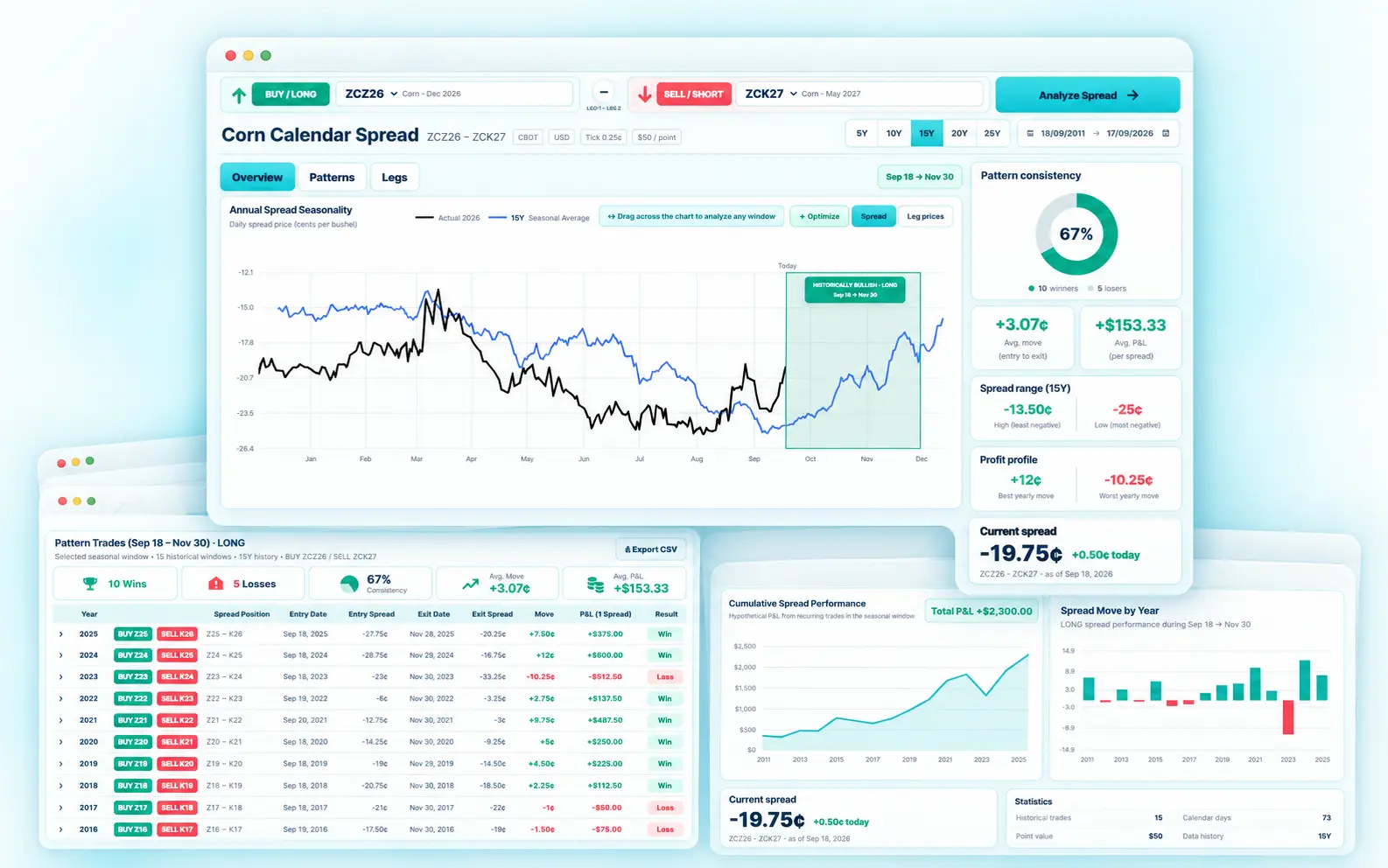
Why recurring behavior can exist
Physical commodity markets often follow production, inventory and consumption cycles. Those cycles can affect nearby and deferred contracts differently.
Dated contracts matter
Seasonality in a calendar spread should be measured using the same delivery-month relationship across years. Mixing different expirations can distort the comparison.
Measure the pattern instead of assuming it
Choose the exact spread, define the dates and compare multiple history windows with the individual seasons behind the average.
Analyze Seasonal BehaviorWhat a seasonal average shows
The average line compresses multiple historical seasons into one path. It can reveal recurring timing, but it hides dispersion unless you also inspect the underlying years.
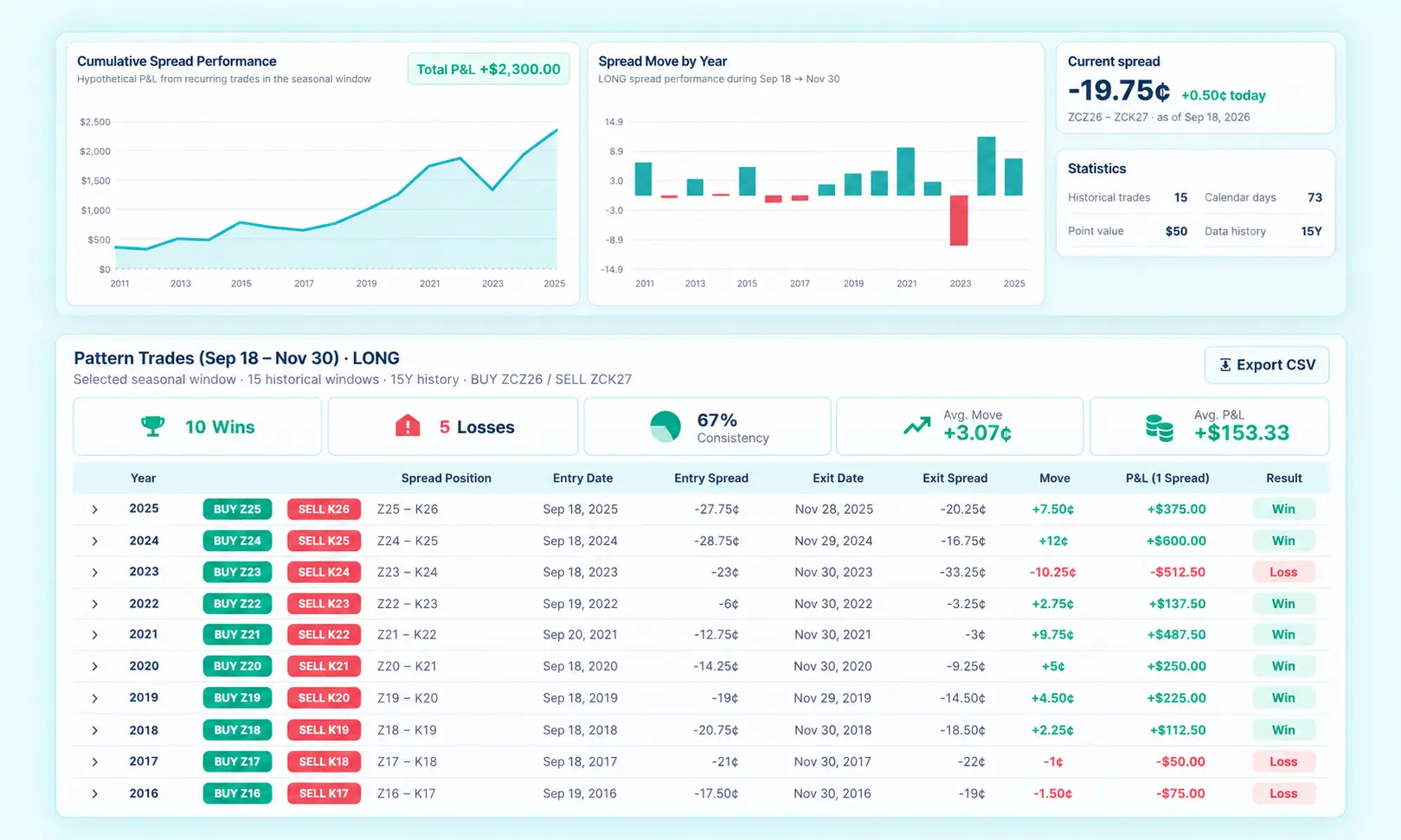
What to check before trusting a pattern
- Number of observations.
- Win rate across individual years.
- Average and median behavior.
- Largest losing seasons.
- Whether recent years differ from older years.
- Current curve regime.
Seasonality in futures is more specific than a simple calendar effect
Every dated futures contract represents a particular delivery month. A seasonal study therefore has to distinguish between the behavior of the commodity and the behavior of one delivery relationship versus another. Two contract months can react differently even when both track the same underlying market.
Many commodity forces are tied to the physical calendar: harvest changes inventories, Natural Gas moves through injection and withdrawal seasons, and refinery demand varies with maintenance schedules.
What should stay constant?
- Contract structure: compare the same delivery-month relationship across years.
- Calculation direction: keep leg order consistent.
- Seasonal dates: use equivalent calendar windows.
- Price convention: avoid mixing settlement and intraday series.
How to interpret a seasonal line
| Metric | Useful interpretation |
|---|---|
| Average path | General historical tendency |
| Median move | Typical middle observation |
| Win rate | Frequency of chosen direction |
| Worst year | Historical downside example |
| Multiple lookbacks | Regime stability check |
If these measures disagree sharply, the disagreement is important evidence rather than something to smooth away.
When seasonality can fail
Patterns can weaken when production methods, storage capacity, regulations, logistics or market participation change. Seasonality should be used as one layer of evidence alongside current curve structure and the recent historical regime.
A worked way to evaluate a seasonal claim
Suppose someone says a Corn spread “usually rallies in autumn.” That statement is too vague to test. Convert it into a precise research question: which two delivery months, which calculation order, what dates, and over how many historical years?
Once the definition is fixed, look at the same window across each year. If 12 of 15 years move in the same direction but the three losing years are extremely large, the result is very different from 12 moderate wins and three small losses. Add the current forward-curve regime to understand whether today's setup resembles the historical sample.
This process turns a market saying into something measurable. It also makes it easier to reject weak ideas quickly instead of forcing a narrative onto the chart.
Explore this cluster
Frequently asked questions
What is futures seasonality?
Futures seasonality is the study of recurring historical behavior at similar times of year. It describes past patterns and does not guarantee future performance.
Why use dated contracts for seasonal spreads?
Calendar spreads depend on exact delivery months. Using dated contracts preserves the specific relationship being tested instead of blending different expirations.
Is the longest lookback always best?
No. Longer history adds sample size, while shorter windows may better reflect recent structural changes. Comparing several windows is usually more informative.
Should I trust the seasonal average?
Only after checking the individual years, losing seasons, dispersion and whether a few outliers dominate the average.
Research seasonal spreads with transparent history
Compare exact delivery months, recurring windows and every historical season behind the pattern.
Open Futures Spread AnalyzerFutures trading involves substantial risk. Historical seasonality is descriptive and does not guarantee future results. This material is for education and research only and is not investment advice.