A calendar spread strategy should begin with a testable idea. Define the exact contract pair, direction, entry window and exit window before evaluating the historical result.
1. Define the economic relationship
Ask why the two delivery months might behave differently. Is the idea tied to harvest, storage, refinery maintenance, heating demand or a known inventory cycle?
2. Check the forward curve
A seasonal pattern observed mostly in contango may behave differently when the current market is in backwardation.
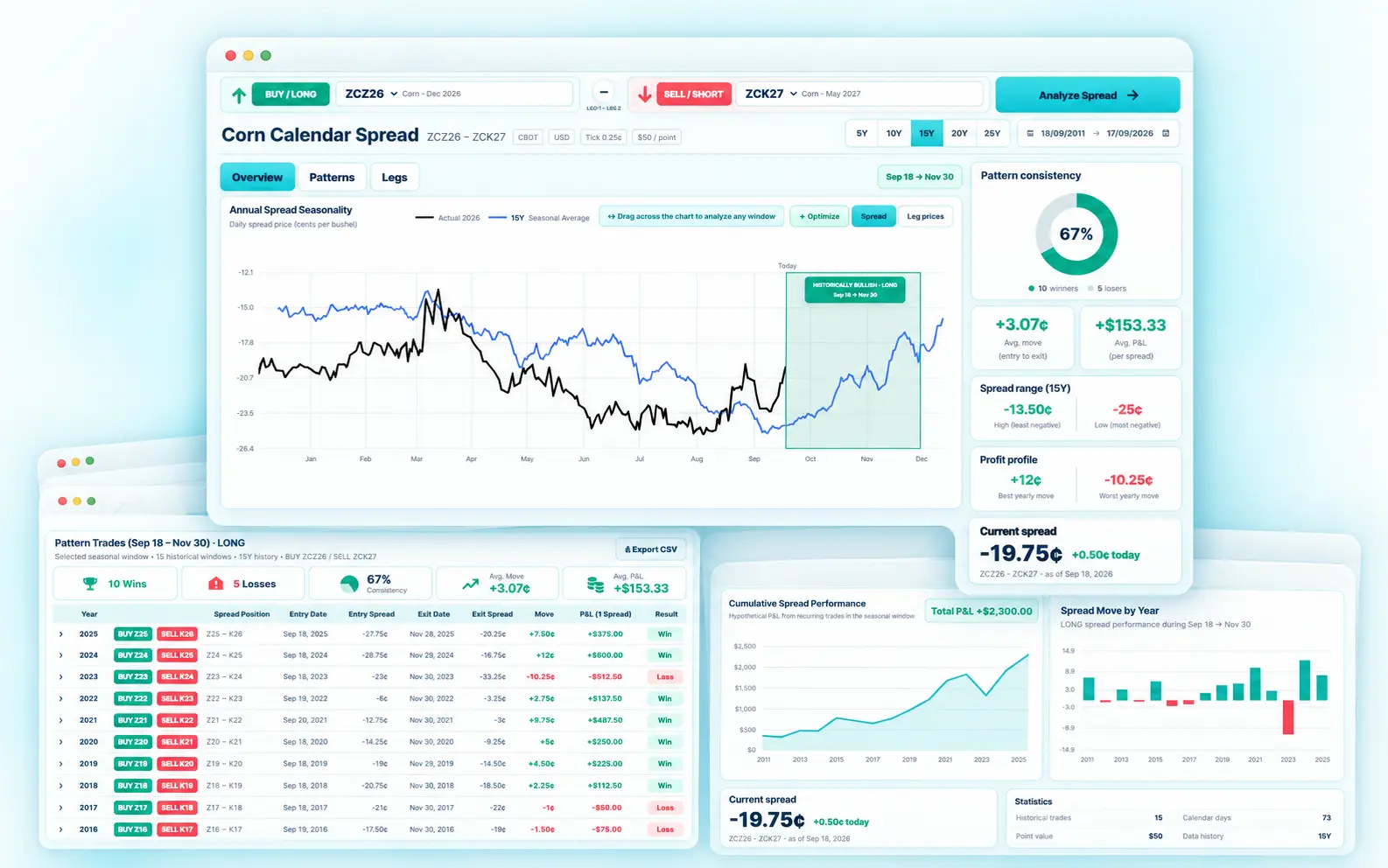
3. Compare multiple lookbacks
Use shorter and longer samples. A recent 5-year pattern and a 20-year pattern can tell different stories, and that difference is valuable information.
Test the relationship with real historical data
Choose the exact delivery months and compare recurring behavior across several lookback windows.
Analyze a Calendar Spread4. Inspect the individual years
Never accept a strong average without checking the underlying seasons. Count wins and losses, examine outliers and measure the worst adverse move.
5. Avoid hindsight optimization
Changing entry and exit dates repeatedly until the chart looks attractive can overfit the past. Treat optimized windows as research candidates that still need robustness checks.
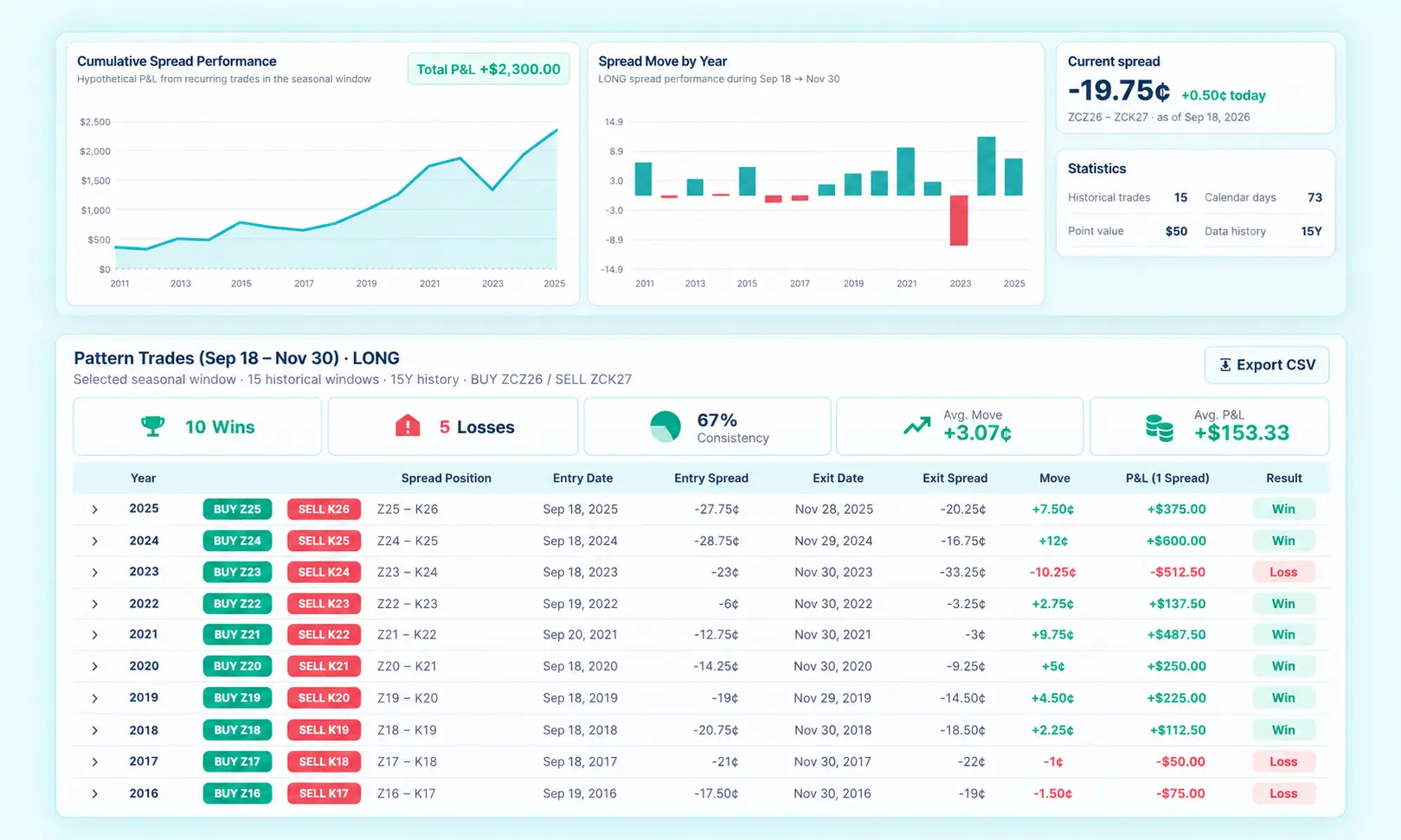
6. Define risk before execution
- Know the contract multiplier and tick value.
- Review liquidity in both legs.
- Measure historical adverse movement.
- Define an invalidation condition.
- Do not treat seasonality as a forecast.
How to turn a spread idea into a repeatable strategy
A strategy needs more than a directional opinion. Define the exact two contracts, the spread formula, the entry rule, the exit rule and the conditions that invalidate the idea. If any of those pieces are decided after looking at the outcome, the backtest becomes harder to trust.
Then separate discovery from validation. Use one part of the history to identify a plausible window and another part to see whether the relationship survives outside the original sample. This is one way to reduce the risk of selecting a pattern purely by chance.
Strategy checklist
| Component | What to define |
|---|---|
| Contracts | Exact delivery months and years |
| Direction | Which leg is long and which is short |
| Window | Entry and exit dates |
| Risk | Maximum acceptable adverse movement |
| Context | Current curve regime and liquidity |
Explore this cluster
Frequently asked questions
What is a calendar spread in futures?
It is a relative-value position using two delivery months of the same underlying futures market.
Why do delivery months trade at different prices?
Storage, financing, inventory, expected supply and demand, seasonality and market structure can all influence the relationship.
Does a calendar spread eliminate risk?
No. The two legs can offset some broad price exposure, but the relationship between contracts can still move sharply.
Why compare individual years instead of only the average?
A smooth average can hide inconsistent outcomes. Individual years show dispersion, losing periods and whether a pattern is robust.
Research your next calendar spread
Use Futures Spread to compare delivery months, seasonal behavior and historical outcomes.
Open Futures Spread AnalyzerFutures trading involves substantial risk. Historical patterns do not guarantee future results. This material is for education and research only and is not investment advice.