The price difference between two delivery months is not arbitrary. It reflects the market's valuation of time between those contracts.
Storage and carrying costs
Physical commodities can incur storage, insurance and financing costs. When supply is comfortable, these carrying costs can help explain why deferred contracts trade above nearby contracts.
Inventory and convenience
When immediate physical supply becomes scarce, nearby delivery can become more valuable than future delivery. This can compress contango or create backwardation.
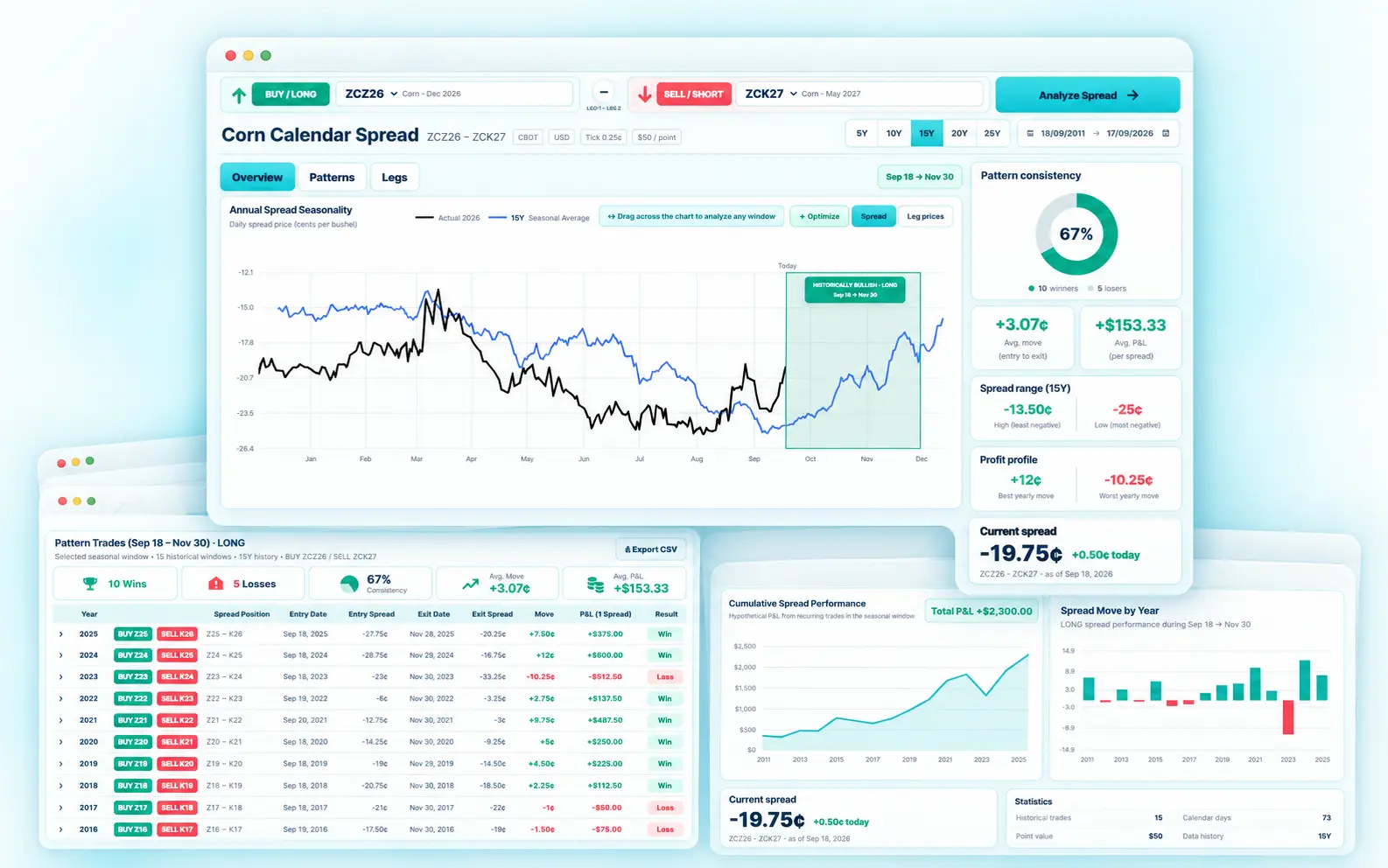
Supply and demand expectations
Weather, crop size, refinery demand, export demand or changing inventories can affect one part of the curve more than another.
Test the relationship with real historical data
Choose the exact delivery months and compare recurring behavior across several lookback windows.
Analyze a Calendar SpreadSeasonality
Recurring production and consumption cycles can create repeated changes in calendar spreads. Agricultural markets are a clear example because planting, growing and harvest occur on a calendar.
Why the formula matters
If you calculate front month minus deferred month, a rising spread means the front month is strengthening relative to the back month. If you reverse the formula, the visual direction reverses too.
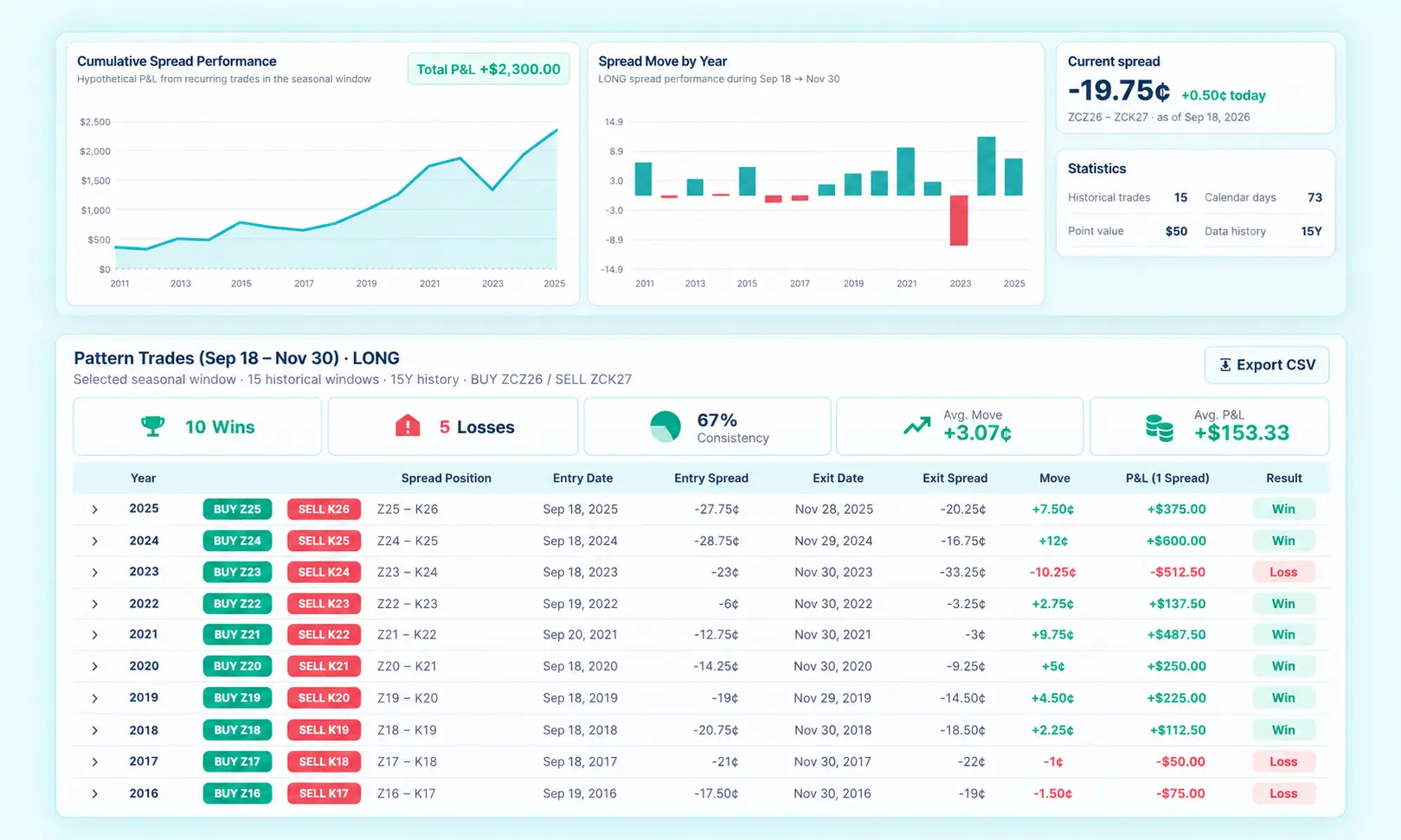
Price is context, not a signal
A spread's current value should be compared with the curve, history and current market regime. A negative or positive number by itself does not imply bullishness or bearishness.
Cost of carry is only one part of the story
Textbook futures pricing often begins with financing and storage, but real calendar spreads can deviate from a simple carry model because inventory availability, delivery constraints and convenience value change through time.
This is especially important in commodity markets where a nearby contract can reflect urgent physical demand. A theoretical carry relationship may explain the broad curve, while local tightness creates sharp moves in one section.
How pricing changes show up in the spread
Suppose the deferred contract remains stable while the nearby contract strengthens. The local curve flattens and a front-minus-back spread rises. If the deferred contract strengthens instead, the same spread falls. The spread therefore converts changes in curve slope into one observable time series.
That is why spread pricing should be read together with the full forward curve rather than in isolation.
Explore this cluster
Frequently asked questions
What is a calendar spread in futures?
It is a relative-value position using two delivery months of the same underlying futures market.
Why do delivery months trade at different prices?
Storage, financing, inventory, expected supply and demand, seasonality and market structure can all influence the relationship.
Does a calendar spread eliminate risk?
No. The two legs can offset some broad price exposure, but the relationship between contracts can still move sharply.
Why compare individual years instead of only the average?
A smooth average can hide inconsistent outcomes. Individual years show dispersion, losing periods and whether a pattern is robust.
Research your next calendar spread
Use Futures Spread to compare delivery months, seasonal behavior and historical outcomes.
Open Futures Spread AnalyzerFutures trading involves substantial risk. Historical patterns do not guarantee future results. This material is for education and research only and is not investment advice.