Wheat futures spreads are used to study the relationship between different delivery months rather than only the outright price of Wheat. The exact contract venue and grade matter because Wheat is traded across multiple futures markets.
Why Wheat spreads can be seasonal
Planting, harvest and storage cycles can affect nearby and deferred contracts differently. The timing varies by crop type and region, so the economic context must be defined before testing a seasonal window.
Storage and carry
When supply is comfortable, carrying costs can support contango. When nearby supply is tight, the curve can flatten or move toward backwardation.
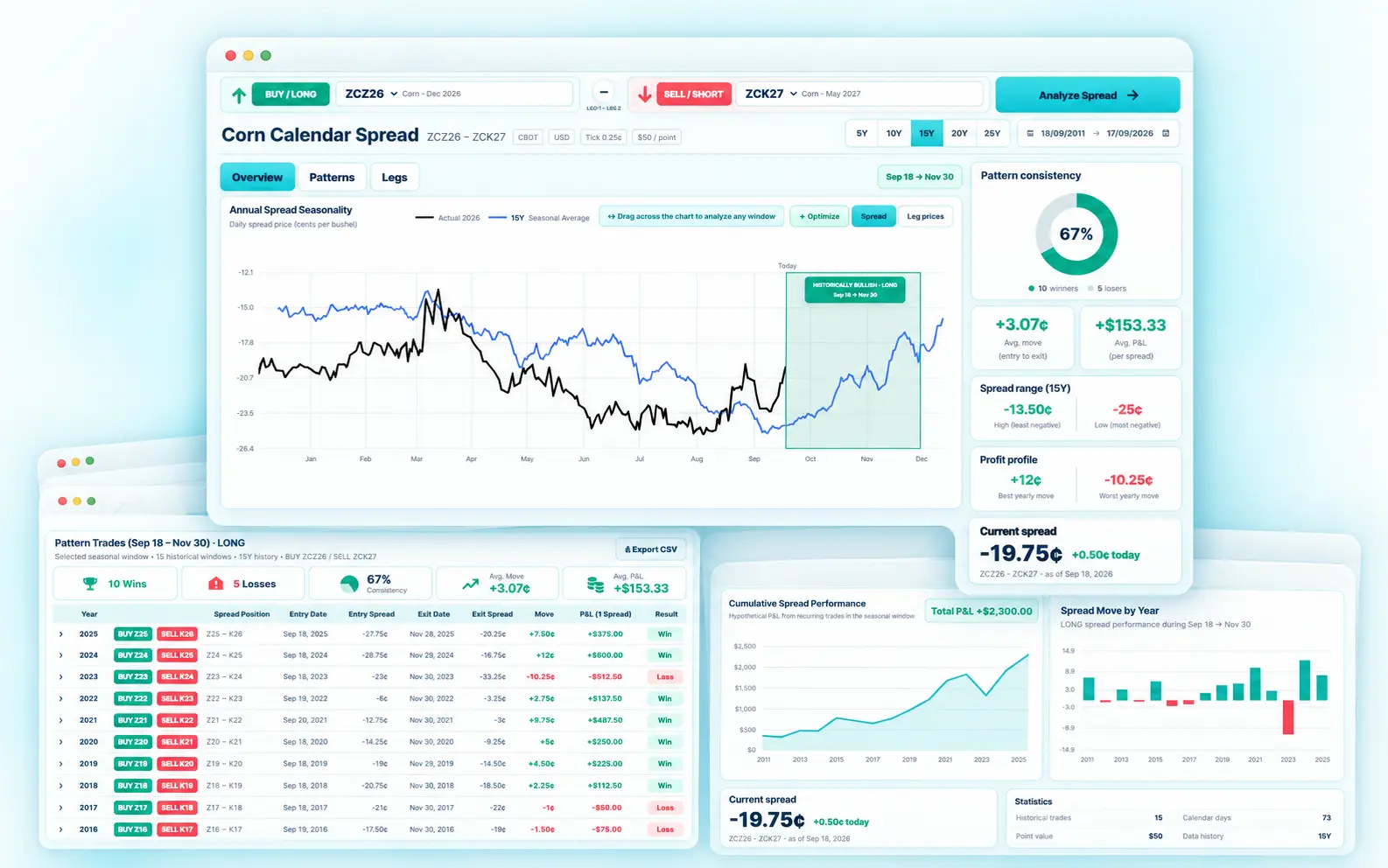
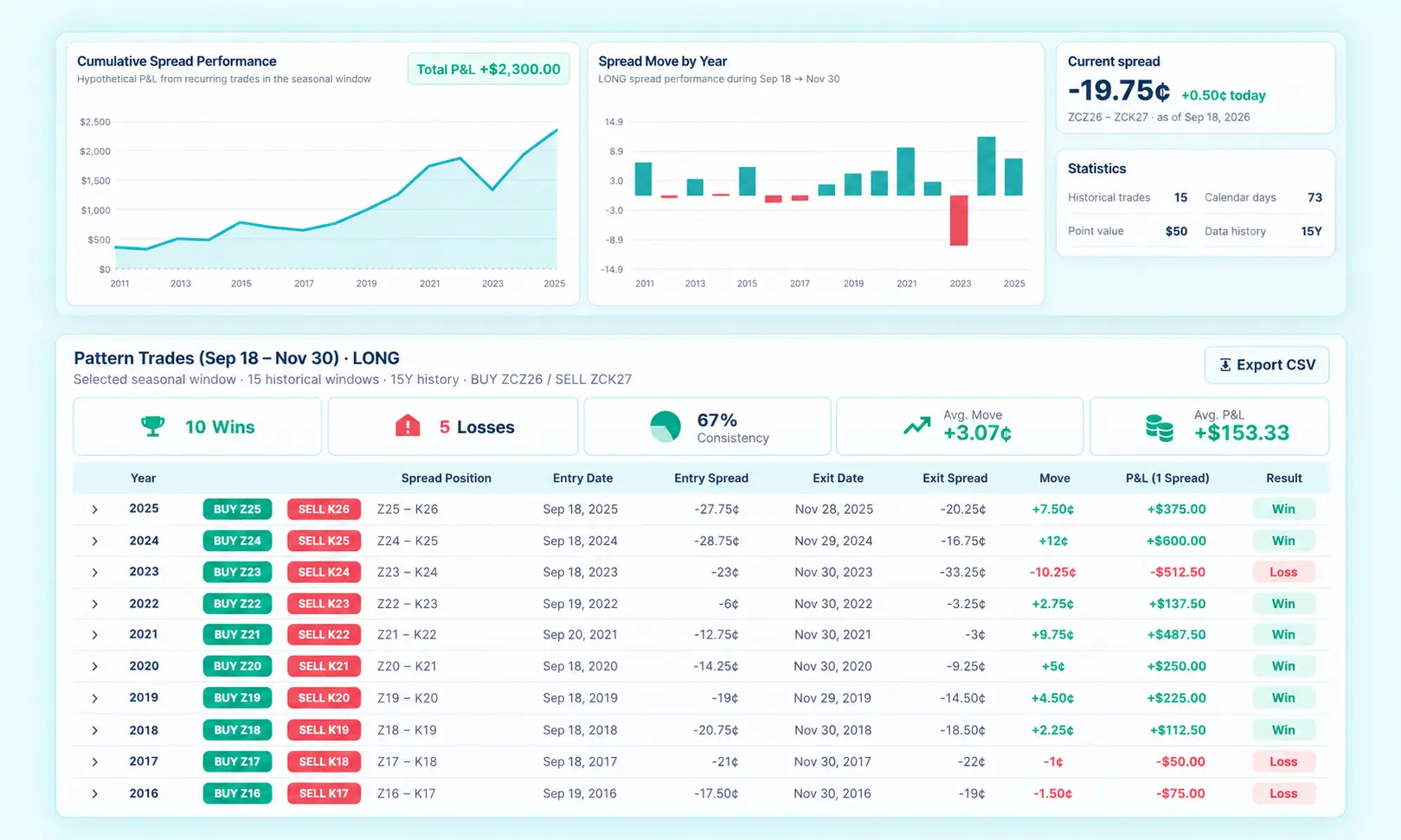
See the workflow with live Corn data
The research process—exact dated contracts, multiple lookbacks, individual years and curve context—is demonstrated in the Corn analyzer.
Open Corn SeasonalityContract specification matters
Do not assume every Wheat contract is interchangeable. Venue, grade, delivery location and month structure can affect the relationship.
Research checklist
- Identify the exact Wheat contract and exchange.
- Define the two delivery months.
- Check current curve structure.
- Compare equivalent dated spreads across history.
- Inspect individual seasons and outliers.
Product note: the current Futures Spread live analyzer is focused on Corn; this Wheat page is educational and illustrates how the same research framework can be applied conceptually.
Wheat spreads require attention to contract specification
Wheat is not one uniform futures market. Different exchanges and grades can represent different delivery economics. A spread study should therefore begin with the exact contract, venue and delivery structure rather than the generic word “Wheat.”
Crop timing and storage
Harvest timing, regional supply and storage costs can affect nearby and deferred Wheat contracts differently. These relationships can create seasonal tendencies, but the timing can vary across crop types and regions.
What makes a Wheat spread comparison valid
- Same futures contract and exchange.
- Same delivery-month relationship across years.
- Consistent price convention.
- Comparable crop-year structure.
- Review of current inventories and curve regime.
The current live Futures Spread analyzer is focused on Corn, so Wheat coverage here is educational rather than a claim of live product support.
Explore this cluster
Frequently asked questions
What is commodity spread trading?
Commodity spread trading focuses on relative price relationships, often between delivery months of the same commodity or between economically related commodity markets.
Why are calendar spreads common in commodities?
Physical commodities have storage, production and demand cycles that can affect nearby and deferred delivery months differently.
Are all commodity spreads seasonal?
No. Some relationships show recurring timing, while others are dominated by changing fundamentals or market structure.
Which commodity does Futures Spread currently analyze live?
The current live product provides detailed dated-contract and seasonal analysis for Corn calendar spreads. The other commodity pages in this cluster are educational.
Use the same research framework on a live Corn spread
Compare exact delivery months, seasonal windows, individual years and current structure in the Futures Spread analyzer.
Open Corn Spread AnalyzerFutures trading involves substantial risk. Historical patterns do not guarantee future results. Educational examples for Wheat, Soybeans, Energy and Gold describe market concepts; the current live Futures Spread analyzer is focused on Corn.