Physical storage
Storage and financing costs can shape the relationship between nearby and deferred contracts.
Commodity spreads compare relative value across delivery months or related markets. Their behavior is shaped by storage, production, inventories, demand cycles and the futures curve.
Commodity spread trading focuses on relationships rather than outright price direction. In the most common intramarket structure, a trader compares two delivery months of the same commodity. Other spreads compare related commodities or processing relationships.
Storage and financing costs can shape the relationship between nearby and deferred contracts.
Agricultural harvests, refinery maintenance and mining supply can create recurring timing effects.
Changes in available supply can alter the premium or discount for immediate delivery.
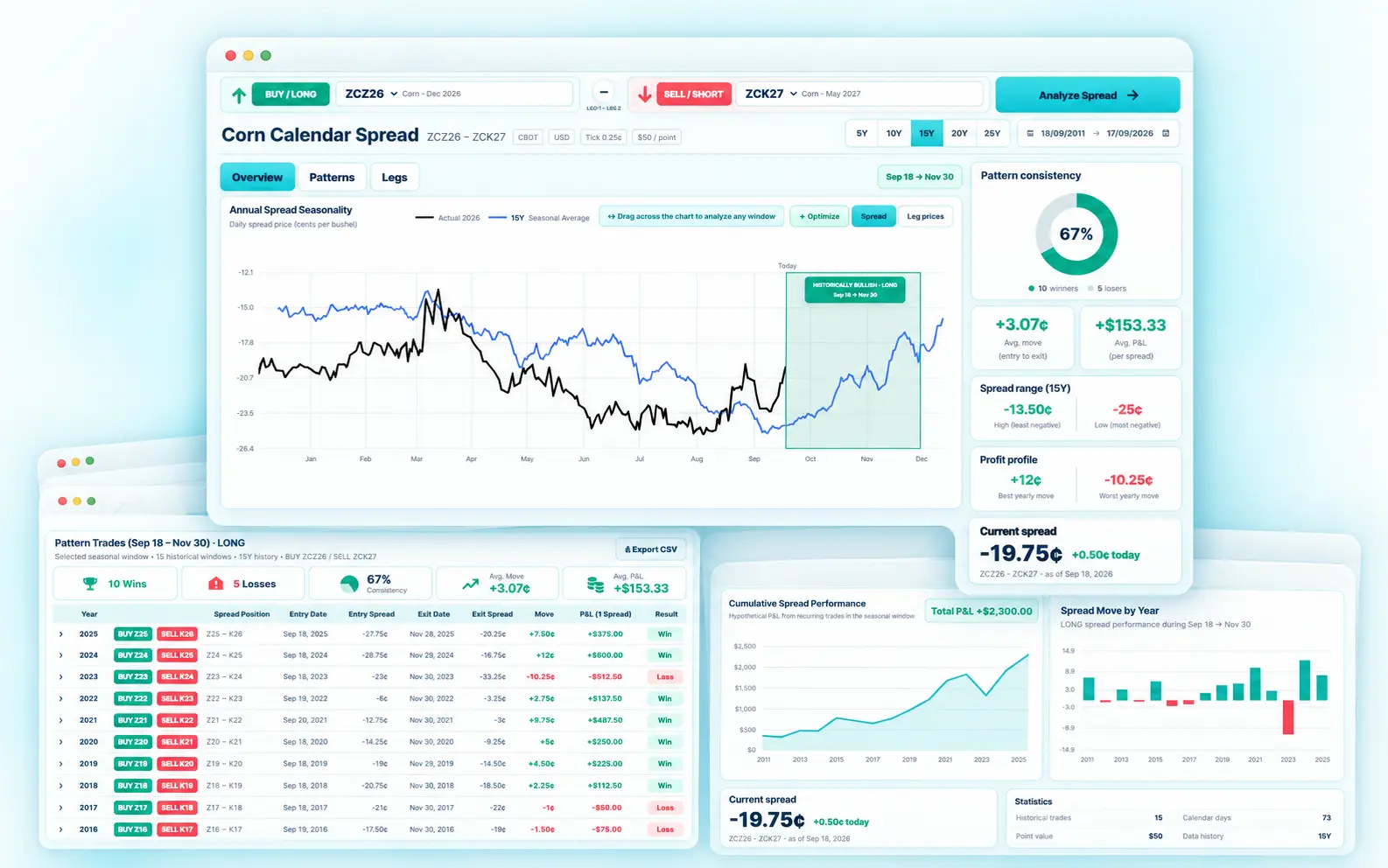
An intramarket spread compares two delivery months of the same commodity, such as December Corn versus May Corn. This is the core structure analyzed by the current Futures Spread product.
Intermarket spreads compare different but economically related markets. They require extra care because contract sizes, volatility and economic drivers can differ.
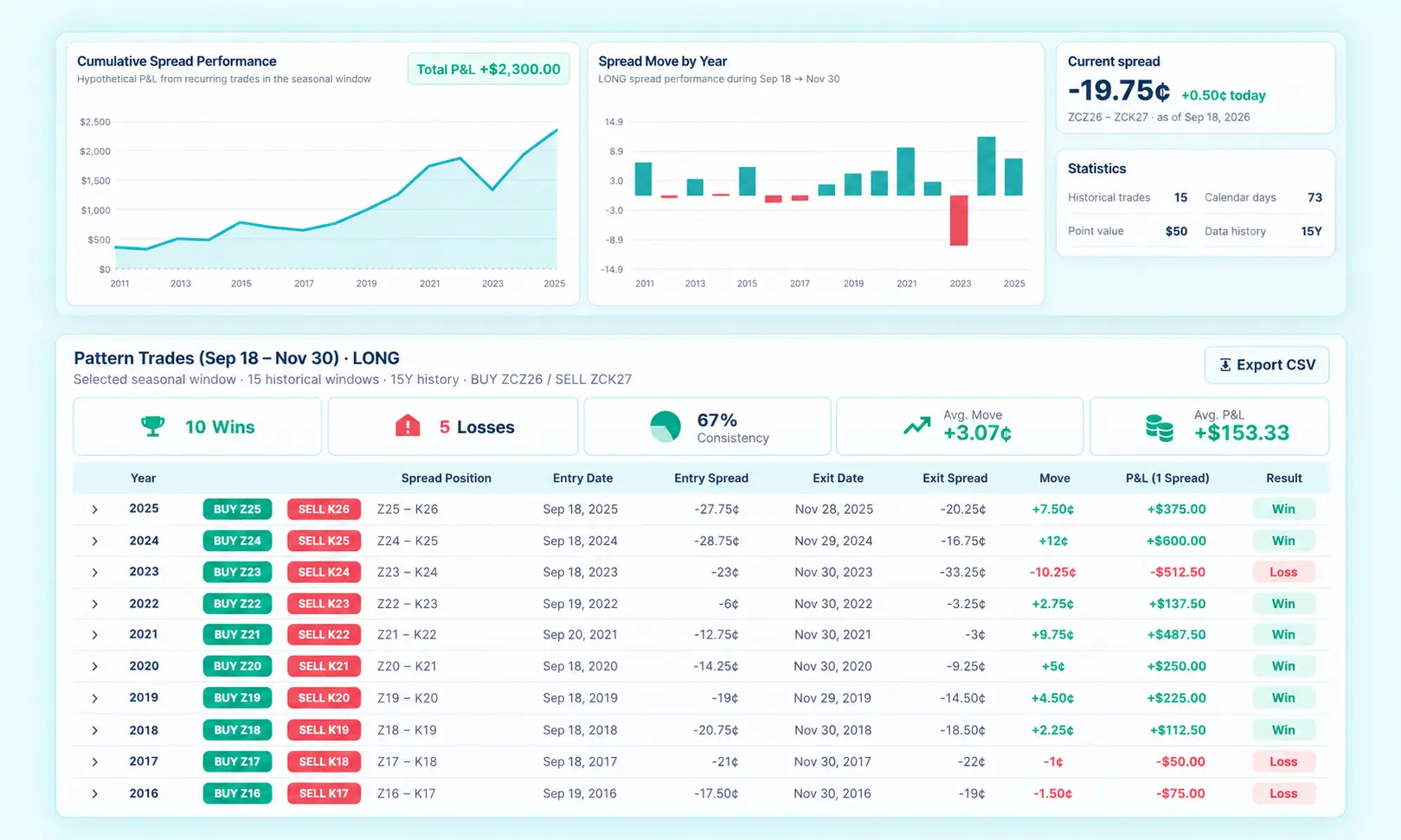
The research process—exact dated contracts, multiple lookbacks, individual years and curve context—is demonstrated in the Corn analyzer.
Open Corn SeasonalityPhysical production and consumption often follow the calendar. Planting, harvest, storage, heating demand, refinery maintenance or jewelry demand can all affect different delivery months at different times.
Contango, backwardation and mixed curves provide essential context. A calendar spread is one segment of that curve, so changes in the local slope directly change the spread.
Spread positions can offset some broad outright exposure, but they remain exposed to relative-value changes, liquidity, contract-specific events and structural regime shifts.
Commodity spread trading is a framework, not one universal strategy. Agricultural markets are shaped by crop cycles. Energy markets depend heavily on inventories and seasonal demand. Metals may be dominated by financing, storage and macro conditions.
The common element is relative value across time or related markets. The economic explanation behind that relationship must be specific to the commodity being studied.
| Type | Example | Main research focus |
|---|---|---|
| Intramarket | December Corn vs May Corn | Time, storage, seasonality, curve shape |
| Intermarket | Related but different commodities | Relative economics, correlation and normalization |
Intramarket spreads are generally easier to interpret because both legs share the same underlying market. Intermarket relationships require extra care with contract size, units and economic comparability.
Use exact contracts, keep the formula consistent, inspect current curve structure and compare multiple historical lookbacks. Do not hide difficult years or assume one seasonal narrative applies across all commodity markets.
The current live Futures Spread workflow demonstrates this process with Corn, where dated contracts and year-by-year historical results are available directly in the product.
Commodity spread trading focuses on relative price relationships, often between delivery months of the same commodity or between economically related commodity markets.
Physical commodities have storage, production and demand cycles that can affect nearby and deferred delivery months differently.
No. Some relationships show recurring timing, while others are dominated by changing fundamentals or market structure.
The current live product provides detailed dated-contract and seasonal analysis for Corn calendar spreads. The other commodity pages in this cluster are educational.
Compare exact delivery months, seasonal windows, individual years and current structure in the Futures Spread analyzer.
Open Corn Spread AnalyzerFutures trading involves substantial risk. Historical patterns do not guarantee future results. Educational examples for Wheat, Soybeans, Energy and Gold describe market concepts; the current live Futures Spread analyzer is focused on Corn.