Futures symbols are compact because they need to identify both the underlying product and the delivery month. Most exchange and data-platform formats combine a product root with a standardized month letter and a year indicator, although the exact display format can vary by vendor.
The 12 standard futures month codes
| Month | Code | Month | Code |
|---|---|---|---|
| January | F | July | N |
| February | G | August | Q |
| March | H | September | U |
| April | J | October | V |
| May | K | November | X |
| June | M | December | Z |
How to read a contract code
Take a symbol such as ZCZ26. In a common market-data convention, ZC identifies corn, Z identifies December and 26 identifies 2026. Another platform may display the same contract differently, so the vendor mapping should always be verified.
ZCZ26 versus ZCK27 compares December 2026 corn with May 2027 corn. The month letter is not decoration—it determines which delivery period is being analyzed.
Not every market lists every month
The standardized month-code alphabet covers all twelve months, but individual futures products may list only certain delivery months. Agricultural contracts, energy contracts and financial futures can have very different listing cycles.
Why symbols matter for seasonal research
A seasonal calendar-spread test must compare equivalent delivery relationships across history. If a December–May spread is the strategy, the historical mapping should remain December versus May for each relevant year rather than silently switching to whichever contracts happen to be most active.
Vendor symbols can differ
Bloomberg, exchange-native feeds, brokers and public data services can represent the same contract using different roots, suffixes or year formats. A reliable data pipeline stores those mappings explicitly and verifies that they point to the same economic contract before combining prices.
Front month is not a contract identity
"Front month" means the nearby contract according to a particular date and convention. It changes over time. A specific code such as December 2026 does not change identity. For spread analysis, that distinction is critical.
Practical checklist before building a spread
- Confirm the product root and exchange.
- Decode the month letter.
- Confirm the full delivery year.
- Check that both contracts use the same price convention.
- Verify vendor-specific symbol mappings.
- Store the exact legs with the backtest definition.
Select the exact contract months
Use the analyzer to choose dated contracts explicitly and keep the contract relationship visible throughout the research process.
Open Futures Spread AnalyzerRelated futures spread guides
Frequently asked questions
What does Z mean in a futures contract code?
Z is the standardized month code for December.
What is the futures month code for March?
H is the standardized code for March.
Do all futures markets trade every month?
No. The month-code standard includes all months, but each product has its own listed expiration cycle.
Why can the same contract have different ticker formats?
Data vendors and trading platforms can use different roots, suffixes and year formats. The underlying product and expiration must be mapped explicitly.
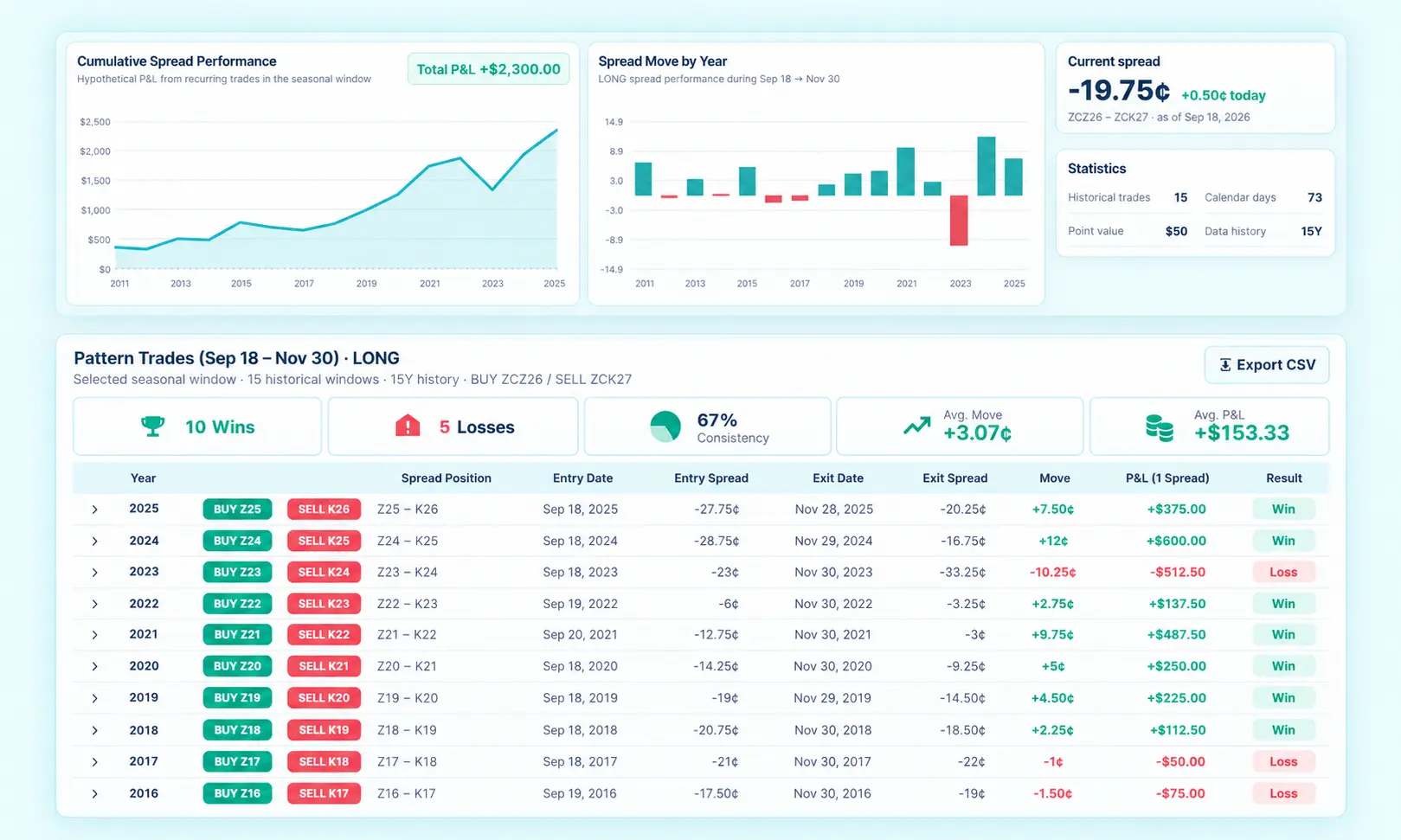
Research the relationship with historical data
Use exact delivery months, multiple lookbacks and current forward-curve context instead of relying on a generic chart.
Open Futures Spread AnalyzerFutures trading involves substantial risk. Historical patterns do not guarantee future results. This material is for education and research only and is not investment advice.