The soybean crush combines soybean (ZS), soybean meal (ZM) and soybean oil (ZL) futures. The ratios 10:11:9 and 1:1:1 both have three markets, but they carry very different quantities. A long products/short beans structure has negative soybean weight and positive meal and oil weights. Reverse every sign to take the other side.
What does 10:11:9 represent?
The board crush is a 30-contract basket: 10 soybean contracts, 11 meal contracts and 9 oil contracts. CME uses this whole-contract ratio to approximate the products of crushing 50,000 bushels of beans. The bean contract represents 5,000 bushels, meal 100 short tons, and oil 60,000 pounds.
| Leg | Long products / short beans | Underlying quantity |
|---|---|---|
| Soybeans · ZS | Sell 10 | 50,000 bushels |
| Soybean meal · ZM | Buy 11 | 1,100 short tons = 2,200,000 lb |
| Soybean oil · ZL | Buy 9 | 540,000 lb |
At an illustrative yield of 44 lb of meal and 11 lb of oil per bushel, 50,000 bushels imply 2,200,000 lb of meal and 550,000 lb of oil. The meal leg matches that yield; the oil leg is 10,000 lb smaller. The ratio is an approximation, not a perfect physical hedge.
−10 × (ZS cents/bu × $50) + 11 × (ZM $/short ton × 100) + 9 × (ZL cents/lb × $600)The multipliers convert a one-unit price quote into dollars per futures contract. ZS is quoted in cents per bushel: one cent on a 5,000-bushel contract is $50. ZM is dollars per short ton: one dollar on a 100-ton contract is $100. ZL is cents per pound: one cent on 60,000 lb is $600.
Why is 1:1:1 different?
One bean, one meal and one oil contract represent 5,000 bushels, 200,000 lb of meal and 60,000 lb of oil. A 5,000-bushel processing equivalent would produce about 220,000 lb of meal and 55,000 lb of oil. Equal contract counts therefore leave a smaller meal leg and a larger oil leg than that physical equivalent. A 1:1:1 signal can behave differently even when the same delivery months and prices are used.
Suppose beans are $12/bu, meal $350/short ton and oil 45¢/lb. The 10:11:9 basket's quoted value is $28,000 (−$600,000 + $385,000 + $243,000). The 1:1:1 basket's quoted value is $2,000 (−$60,000 + $35,000 + $27,000). These are different basket valuations. A trade's P&L is the change in its basket value between entry and exit, after direction and costs—not the starting valuation.
How to compare them fairly
- Match the exact delivery month and year of each of the three legs.
- Keep the direction and weights visible in the chart title and export.
- Use each contract's dollar multiplier; never compare the two baskets as though they had identical notional size.
- Evaluate yearly outcomes, adverse moves, liquidity and cash margin requirements separately.
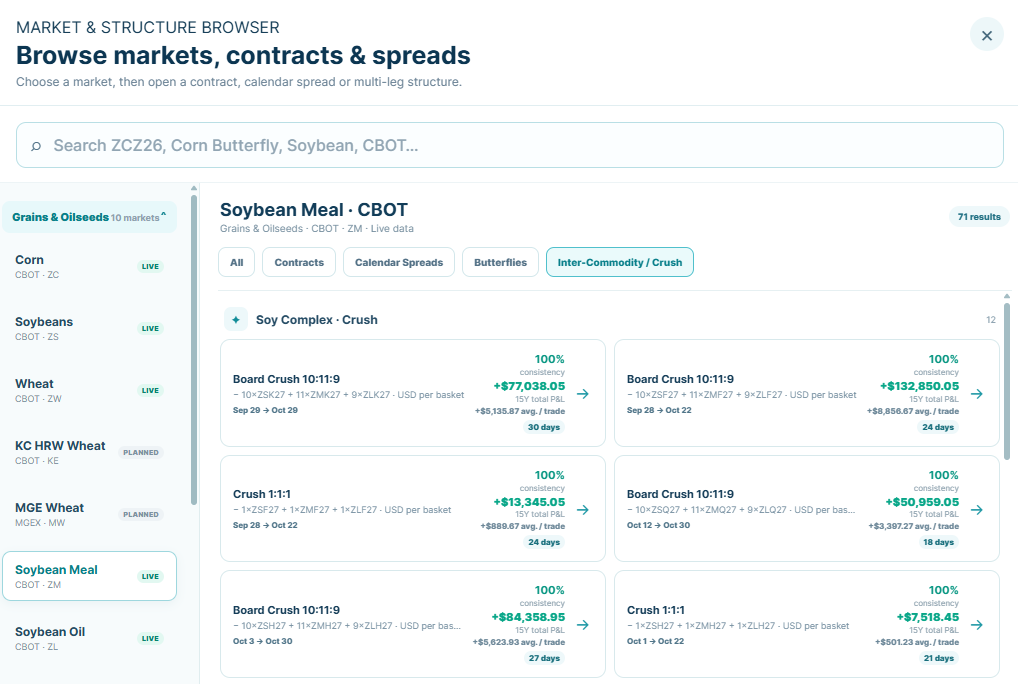
Compare both structures in the product
Open the market browser and inspect the ratio in each result before reading its historical window.
Browse Crush Structures →Primary references
CME Group: Soybean Crush Spreads · CME Group: Grain and Oilseed Overview.
Frequently asked questions
Is 10:11:9 a 30-contract position?
Yes. It consists of 10 soybean, 11 meal and 9 oil futures contracts, subject to the chosen direction.
Does 1:1:1 equal a scaled-down board crush?
No. Scaling 10:11:9 down proportionally would not yield one contract of each market; the physical exposures differ.
Does the current basket value equal my profit?
No. Profit or loss depends on the change in basket value from the entry price to the exit price, position direction and trading costs.
Analyze a dated crush structure
Check the selected legs, ratio and history in the product before drawing any conclusion.
Browse Crush StructuresEducational material only, not investment advice. Historical results are hypothetical and do not guarantee future performance. Unless stated otherwise, worked prices are illustrative and trading costs are excluded.