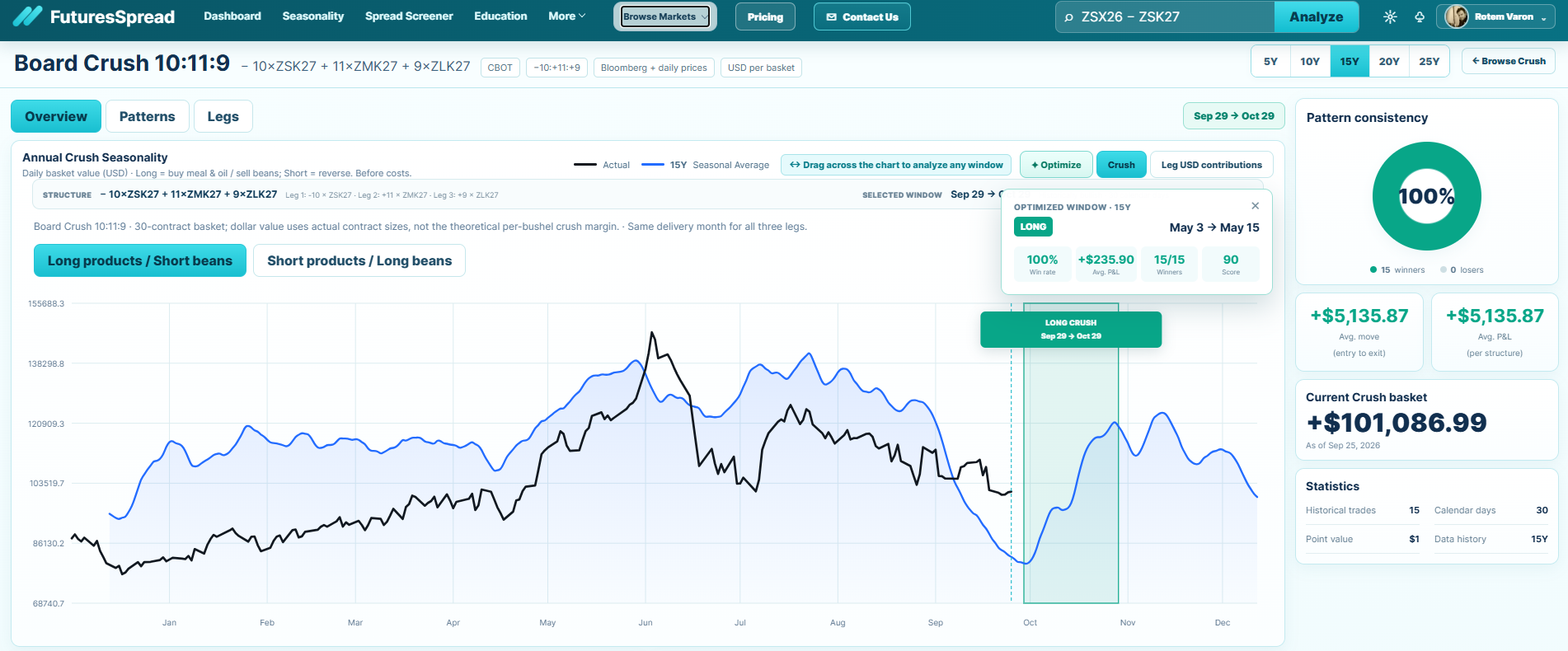
The gross soybean crush margin compares the value of meal and oil obtained from one bushel of beans with the cost of that bushel. This is an illustrative processing price relationship. It is not net operating profit and it is not automatically the dollar P&L of a futures position.
Start with three quote units
| Market | Common quote | Illustrative yield per bean bushel |
|---|---|---|
| Soybeans · ZS | $/bushel (or cents/bushel on a futures screen) | One bushel of input |
| Soybean meal · ZM | $/short ton | 44 lb of output |
| Soybean oil · ZL | Cents/lb | 11 lb of output |
One short ton is 2,000 lb, so 44 lb of meal is 44 ÷ 2,000 = 0.022 short tons. Eleven pounds of oil priced in cents/lb is 11 × oil price ÷ 100 dollars, which is 0.11 × the numeric oil quote in dollars. Convert the soybean quote to dollars per bushel if your screen shows cents.
(Meal $/short ton × 0.022) + (Oil cents/lb × 0.11) − Soybeans $/bushelWorked example
Meal at $350/short ton contributes $7.70/bu. Oil at 45¢/lb contributes $4.95/bu. Beans at $12/bu cost $12. The illustrative gross margin is $7.70 + $4.95 − $12.00 = $0.65/bu. None of these quotes is a current market price.
The implied gross product value is $12.65 per bushel, but that does not mean a processor earns 65 cents in cash. Extraction yields, plant costs, freight, quality, basis, financing and physical sales terms are outside this formula.
Why the futures basket is a different number
A 10:11:9 board basket contains 50,000 bushels of bean exposure, 1,100 short tons of meal and 540,000 lb of oil. At the hypothetical prices above, its quoted basket value is −$600,000 + $385,000 + $243,000 = $28,000. Multiplying the theoretical $0.65/bu by 50,000 bushels yields $32,500. The $4,500 difference is the 10,000 lb of oil yield that nine whole futures contracts do not cover at 45¢/lb.
For a long products/short beans trade, the gross futures move is basket value at exit minus basket value at entry. Reverse the sign for the opposite direction. Enter and exit all legs on matching dates when backtesting, then consider execution costs. A snapshot of the basket at one date is never itself a trade return.
Three easy errors to catch
- Cents versus dollars: oil 45¢/lb enters the formula as 45, not 0.45. A soybean screen showing 1,200¢/bu means $12/bu.
- Physical formula versus contract P&L: the 0.022 and 0.11 factors are per-bushel yield conversions. Futures P&L uses the actual contract multipliers and chosen leg weights.
- Gross versus net: the formula has no processing, transport, fees, bid–ask or financing deduction.
Use the actual contract weights
Check the three dated legs and the displayed USD basket before comparing historical results.
Open the Crush Analyzer →Primary reference
CME Group: Understanding Soybean Crush.
Frequently asked questions
Why multiply meal by 0.022?
The conventional yield is 44 lb of meal per bushel, or 0.022 of a 2,000-lb short ton.
Why multiply oil by 0.11?
The numeric quote is cents per pound. Eleven pounds divided by 100 converts the product value into dollars per bushel.
Is gross crush margin the margin deposit required by my broker?
No. Gross processing margin measures a price relationship; futures performance bond or account margin is a separate cash requirement.
Analyze a dated crush structure
Check the selected legs, ratio and history in the product before drawing any conclusion.
Browse Crush StructuresEducational material only, not investment advice. Historical results are hypothetical and do not guarantee future performance. Unless stated otherwise, worked prices are illustrative and trading costs are excluded.