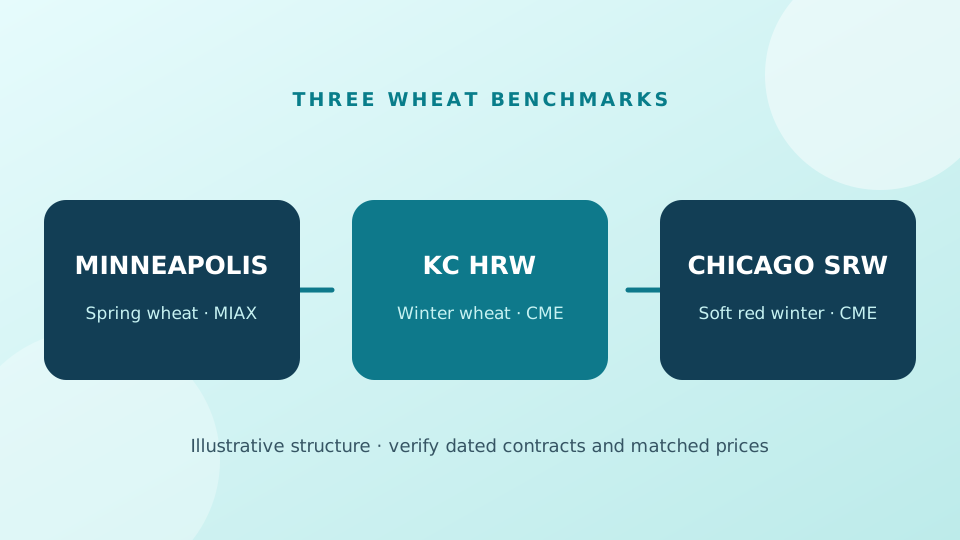
Two hard red spring wheat contracts can have similar names while belonging to different venues and data histories. This guide keeps the exchange, dated legs and historical-data boundary visible so the quoted relationship can be checked.
The 2025 platform change
CME announced that order routing and market data for MGEX products would cease on CME Globex from the June 30, 2025 trade date. MIAX Futures continues to offer its Minneapolis hard red spring wheat product on the Onyx platform. CME launched a separate CBOT hard red spring wheat future in April 2025. These announcements concern market access and new product identity; they do not imply that the Minneapolis physical market disappeared.
The exchange notices are the starting point when a Bloomberg chart for an older ticker shows “no available data.” A chart failure alone cannot establish that every venue has stopped trading. Check the exchange and vendor mapping, the exact dated contract and the requested price field before drawing that conclusion.
Different symbols, different ledgers
MIAX publishes MWE as the Onyx ticker and lists BBG MWE in its vendor-symbol table. CME publishes HRS as its Globex code and KFP Comdty as its Bloomberg vendor root. A data pipeline should keep MIAX Minneapolis history and CME CBOT HRS history in distinct instrument records, even if both are described as spring wheat.
Do not append a CME HRS close to an MIAX Minneapolis contract simply because the first source has a gap. A legitimate comparison needs two separate time series with date-matched observations and an explicit spread formula. A legitimate historical continuity analysis also needs an identified methodology for any series break.
Implications for seasonality
A 15-year Minneapolis average uses dated MIAX/MGEX contracts from its own historical source. A newly listed CME contract cannot have the same 15-year dated history. If a screen stitches the newer quote onto the old history, the average and the “current” overlay would silently mix products with different rules and possibly different delivery economics.
The safe workflow is to label venue and source on every chart, report the last available observation and suppress current metrics when the current Minneapolis leg is missing. A CME-vs-MIAX comparison can be a separate research subject only after both dated legs and their overlapping dates are verified.
See the dated contracts behind the formula
Explore matched historical Minneapolis prices, individual years and the selected date window. The dataset has no verified current MGE spread.
Open MGE Historical Research →Primary sources
Exchange and USDA sources establish product definitions and context. Recheck the current rules and dates before using a contract.
Continue this series
Educational historical research, not investment advice. Futures and multi-leg spreads involve substantial loss, execution and delivery risk. Historical results do not guarantee future outcomes. Imported Minneapolis prices stop on 24 October 2025; current quotes and margin must be verified independently.