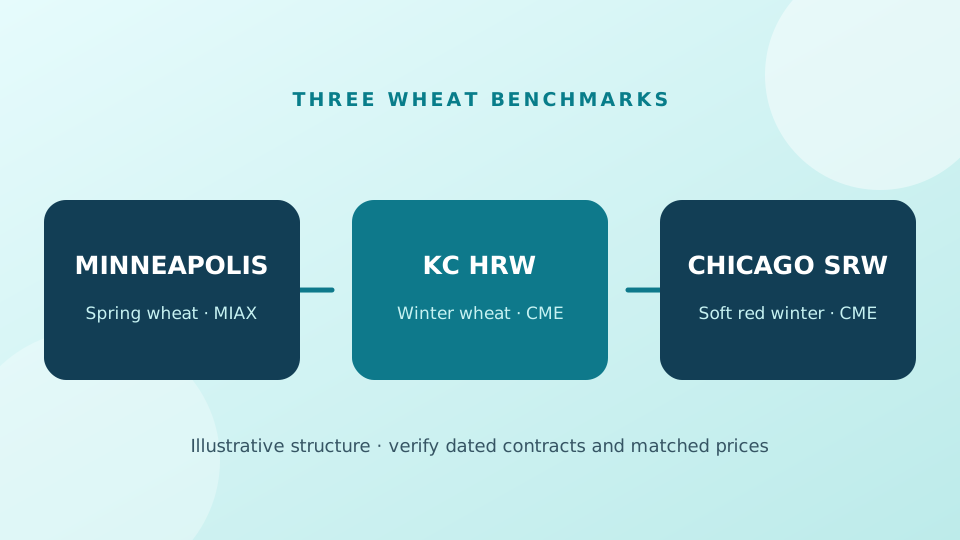
Market identity, grain class and delivery economics are part of the formula. This guide keeps the exchange, dated legs and historical-data boundary visible so the quoted relationship can be checked.
Three different benchmarks
Minneapolis hard red spring wheat, Kansas City hard red winter wheat and Chicago soft red winter wheat represent related but distinct physical markets. They can respond to common global grain factors while diverging when a regional crop, quality specification or delivery channel changes. Calling all three simply “wheat” erases the reason a cross-market spread moves.
The contract name is not enough. Record venue, delivery month, year, grade and cash-delivery terms. MIAX Minneapolis futures and CME CBOT HRS are also distinct exchange products even though both reference hard red spring wheat.
What one-to-one means
The three full-size contracts in the research comparison are quoted in cents per bushel and use 5,000-bushel lots. That makes a one-to-one price difference interpretable in cents per bushel and a one-cent movement worth $50 before costs for the paired position. The numerical balance does not eliminate crop-specific or basis risk.
A trading ratio based on different risk sensitivities could differ from one-to-one, but then the formula and dollar-per-unit calculation must change explicitly. Never present a chart generated with one ratio next to P&L calculated using another.
When comparisons break
A venue changes a delivery rule, a contract reaches a different liquidity regime, or a vendor supplies a different price field. Any of these can move a reported difference independent of the economic thesis. Annotate rule changes and compare source definitions before claiming a long-term stable premium.
A robust historical study keeps each benchmark in its own series, joins same-day observations, reports gaps and distinguishes a quoted relationship from an exchange-listed or broker-supported spread order.
See the dated contracts behind the formula
Explore matched historical Minneapolis prices, individual years and the selected date window. The dataset has no verified current MGE spread.
Open MGE Historical Research →Primary sources
Exchange and USDA sources establish product definitions and context. Recheck the current rules and dates before using a contract.
Continue this series
Educational historical research, not investment advice. Futures and multi-leg spreads involve substantial loss, execution and delivery risk. Historical results do not guarantee future outcomes. Imported Minneapolis prices stop on 24 October 2025; current quotes and margin must be verified independently.