A clear framework for comparing Minneapolis hard red spring wheat with Chicago soft red winter wheat. This guide keeps the exchange, dated legs and historical-data boundary visible so the quoted relationship can be checked.
Do not compare labels alone
Minneapolis hard red spring and Chicago soft red winter are different wheat classes. A same-month difference, quoted Minneapolis minus Chicago, may be useful for relative-value research, but the price gap is not a universal quality premium. Delivery location, freight, grades, regional supply and cash-market demand all contribute.
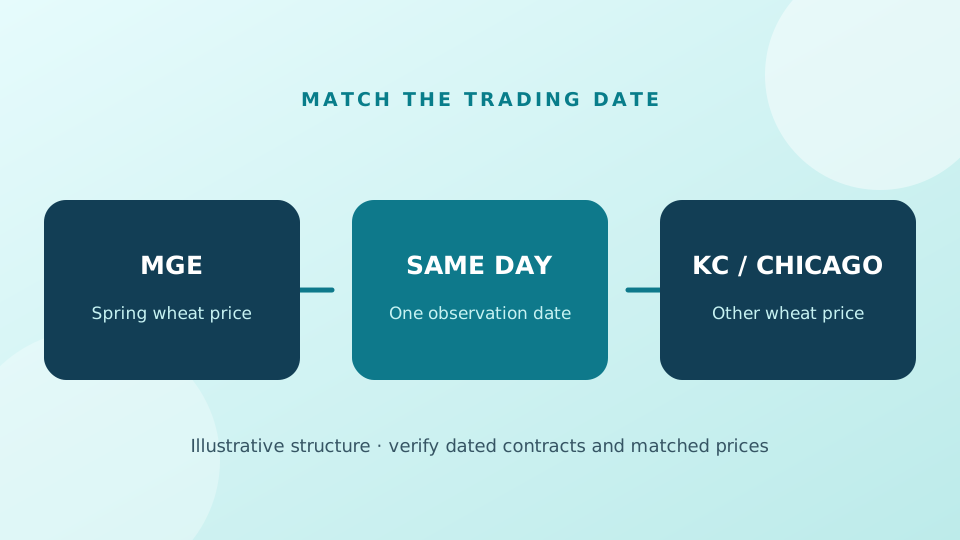
Choose the same delivery code and year on both sides when studying the contemporaneous relationship. Then join dated futures prices on the trading date. Using a spring wheat observation from 2025 against a Chicago 2026 close because both contracts are labeled Z26 would invent a spread that never existed at one time.
Exchange context
MIAX identifies Minneapolis HRSW as its flagship Onyx futures product. CME lists Chicago SRW wheat as a separate product and also offers a newly launched CBOT HRS contract. CME’s HRS–Chicago exchange spread is not automatically the same trade as MIAX Minneapolis–Chicago, even if both use spring-wheat terminology.
A broker may charge different margins for a cross-venue pair than for two legs at one clearinghouse. Before planning any position, verify the exact contract identifiers, order type, clearing path and all-in costs for the specific pair.
Read the historical evidence
A useful chart includes a raw spread line in cents per bushel, a clearly defined sign, data source, selected years and observation counts. Review each historical season for reversals and the deepest adverse move, then compare the pattern with crop-year and storage context. A single average line can hide a structural change in delivery or benchmark economics.
FuturesSpread’s historical MGE page offers the MGE–Chicago same-month comparison but labels it historical only. Without verified recent Minneapolis prices it has no current quoted relationship and cannot produce a present-day trade signal.
See the dated contracts behind the formula
Explore matched historical Minneapolis prices, individual years and the selected date window. The dataset has no verified current MGE spread.
Open MGE Historical Research →Primary sources
Exchange and USDA sources establish product definitions and context. Recheck the current rules and dates before using a contract.
Continue this series
Educational historical research, not investment advice. Futures and multi-leg spreads involve substantial loss, execution and delivery risk. Historical results do not guarantee future outcomes. Imported Minneapolis prices stop on 24 October 2025; current quotes and margin must be verified independently.