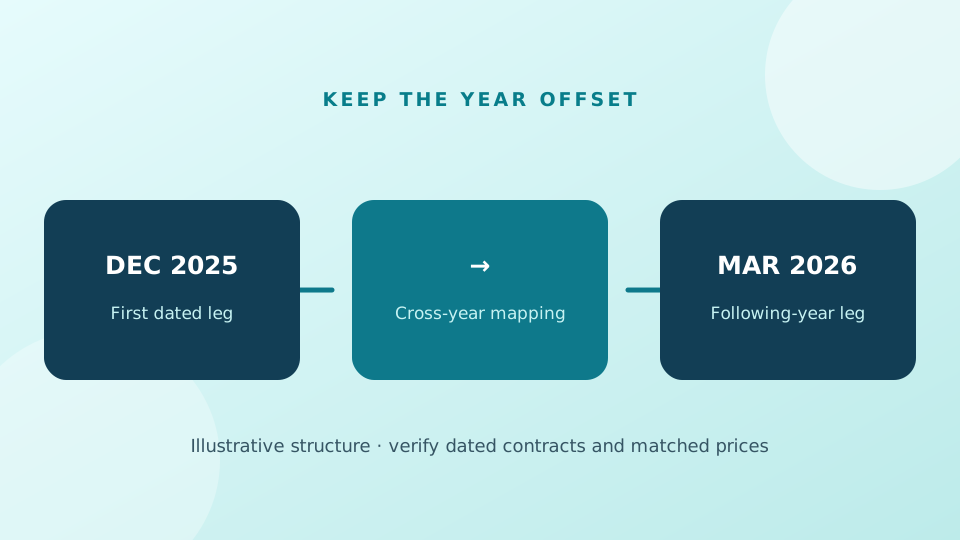
Connect a September delivery month to observed crop progress without assuming the same harvest date every year. This guide keeps the exchange, dated legs and historical-data boundary visible so the quoted relationship can be checked.
The meaning of “new crop”
MIAX lists September as its new-crop delivery month for Minneapolis hard red spring wheat. That helps organize July, September and December calendar comparisons, but the label alone cannot explain a price move. Planting, growing conditions, harvest pace, quality and inventories develop differently from year to year.
A July–September spread and a September–December spread straddle different parts of the crop transition. The first compares a nearby pre-harvest relationship with the new-crop month; the second considers the new-crop month relative to later delivery. The precise economics depend on the year’s cash market.
Use independent context
USDA Crop Progress reports track weekly crop stages during the growing season, while WASDE publishes monthly supply-and-use estimates. Overlay report dates or summarize crop-stage conditions next to historical spread years rather than treating a static “harvest date” as a fact. A month with delayed development may behave unlike the same calendar month in an early season.
A fair comparison should ask whether a recurring spread window still appears across both early and late crop years. If the supposed signal depends on one narrow set of unusually favorable seasons, publish that limitation.
Trading dates and notice dates
Agronomic timing is not the only clock. Futures delivery notices and last-trade dates place operational boundaries on a nearby contract. MIAX’s specification states first notice in the last business day before the delivery month and trading ending before the 15th calendar day of the month. Check the current rules and exit before exposure you cannot handle.
A backtest should exclude a year if a leg lacks valid prices at the planned exit. Shifting to a distant price without explaining the date change makes hypothetical results look more complete than the tradable record.
See the dated contracts behind the formula
Explore matched historical Minneapolis prices, individual years and the selected date window. The dataset has no verified current MGE spread.
Open MGE Historical Research →Primary sources
Exchange and USDA sources establish product definitions and context. Recheck the current rules and dates before using a contract.
Continue this series
Educational historical research, not investment advice. Futures and multi-leg spreads involve substantial loss, execution and delivery risk. Historical results do not guarantee future outcomes. Imported Minneapolis prices stop on 24 October 2025; current quotes and margin must be verified independently.